
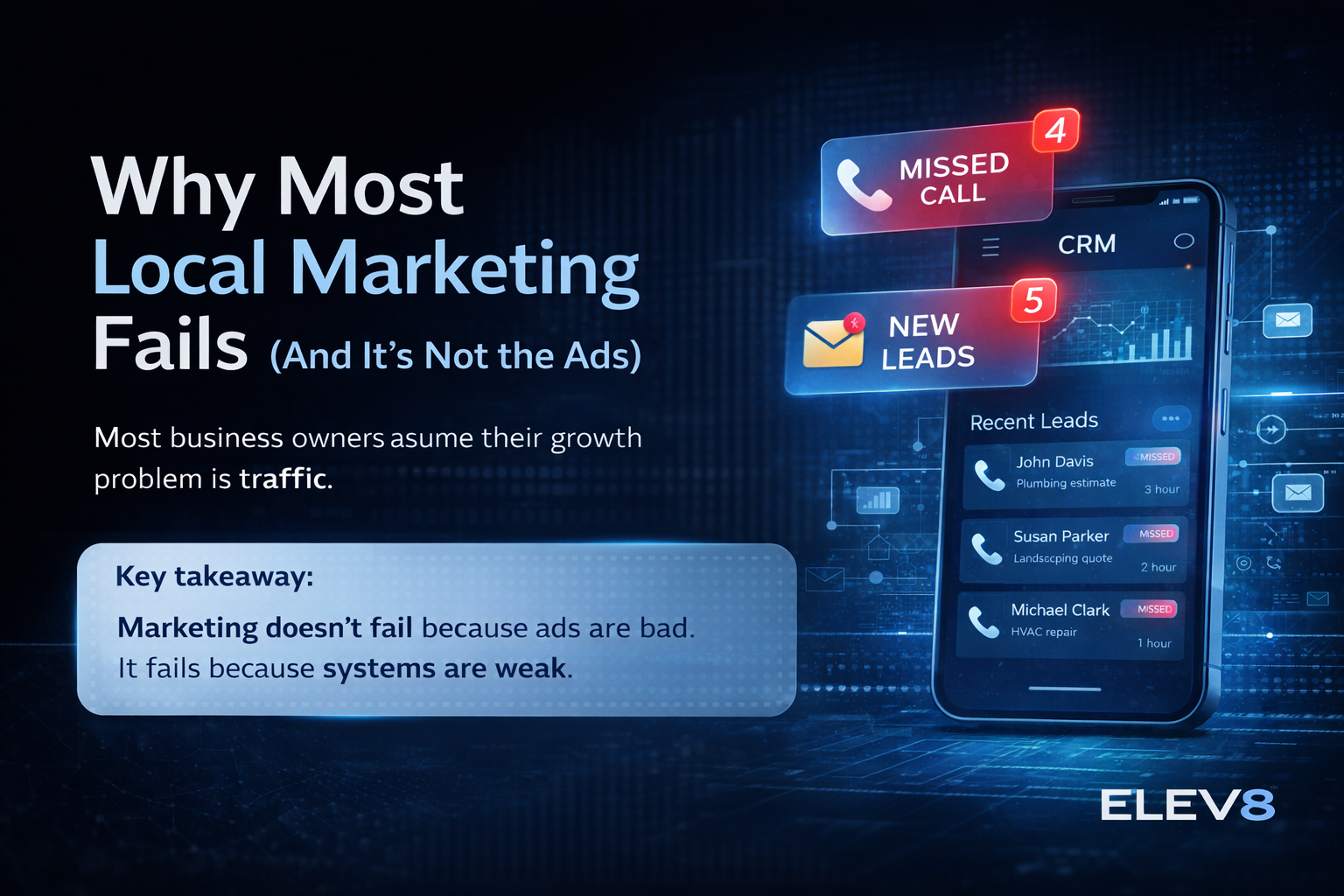
Why Most Local Marketing Fails (And It’s Not the Ads)
Most business owners assume their growth problem is traffic. It isn’t.
Introduction:
Local marketing rarely fails because of poor ads. It fails because of broken operations.
If response time exceeds five minutes, if calls go unanswered, if routing is unclear, if follow-up is inconsistent; no campaign will save you.
Before amplification, there must be integrity.
The Real Problem: Lead Leakage
When a prospect submits a form or calls your office, they are at peak buying intent.
If that moment is mishandled, the probability of conversion drops dramatically.
Common leakage points:
Calls unanswered during business hours
Forms sitting idle in inboxes
No routing logic for territories or departments
No CRM enforcement
No follow-up automation
No visibility into source attribution
Most businesses are unknowingly losing 20–40% of potential revenue due to operational gaps.
And then they increase ad spend.
Speed-to-Lead Is a Revenue Variable
The first five minutes matter more than the first five ads.
If response time exceeds five minutes:
Contact rate declines
Conversion probability drops
Cost per acquisition increases
ROI becomes unpredictable
You cannot outspend slow response.
You must out-discipline it.
Marketing Is an Operations Problem First
Traffic amplifies whatever system exists.
If your system is:
Unstructured
Untracked
Unaccountable
Then ads simply amplify chaos.
This is why Elev8 operates in reverse.
We install:
Lead capture integrity
Routing accountability
Speed-to-lead automation
CRM visibility
Attribution tracking
Only then do we scale traffic.
The Reverse Marketing Model
Most agencies follow this order:
Run ads
Generate leads
Hope internal teams convert
We follow this order:
Install infrastructure
Enforce response discipline
Verify tracking accuracy
Then scale traffic
Because scalable growth requires controlled systems.
Why Service Businesses Feel This Most
Service and facility-based businesses depend on:
Recurring revenue
High lifetime value
Territory-based demand
If even 15% of leads go uncontacted, the financial impact compounds.
Marketing performance isn’t just about cost per lead.
It’s about:
Lead handled ÷ Lead generated.
Franchise Brands Face an Even Bigger Risk
Multi-location operators often experience:
Inconsistent response standards
Territory overlap
Fragmented tracking
Local ad spend without central visibility
Without routing logic and accountability, scale becomes expensive chaos.
If You’re Scaling, Ask These Questions
Before increasing budget, evaluate:
Are all inbound calls answered?
Is response time under five minutes?
Is routing logic documented?
Can you see close rate by source?
Do you track revenue attribution?
If any answer is unclear, the issue is structural.
Growth Requires Discipline
Marketing doesn’t fail because ads are bad.
It fails because systems are weak.
Predictable growth comes from:
Operational clarity
Enforced process
Data visibility
Phase-based scaling
Traffic is an amplifier.
Infrastructure is the multiplier.
Final Thought
If your business depends on predictable pipeline, operational integrity is not optional.
Before scaling traffic, evaluate your system.
Because disciplined growth isn’t built on campaigns.
It’s engineered.

